
Pest control compliance is one of those areas where many commercial property operators, strata managers, and facilities managers assume they are covered — until an auditor, council officer, or insurance assessor asks for documentation that does not exist.
Whether you are preparing for a routine building audit, responding to a council health inspection, renewing a commercial lease, or simply trying to get your strata scheme's compliance file in order, understanding what auditors actually look for in a pest management context can save you significant time, cost, and exposure.
This checklist covers the key areas that experienced auditors, environmental health officers, and compliance reviewers assess when evaluating commercial pest control programs in New South Wales — and what you need to have in place to demonstrate that your building or portfolio is being managed to the required standard.
1. Licensed Pest Management Technicians
The first thing any competent auditor will verify is whether the pest control work carried out on your property has been performed by a licensed pest management technician.
In New South Wales, pest management technicians must hold a current licence issued under the Pesticides Act 1999 (NSW), administered by the NSW Environment Protection Authority (EPA). There are different licence categories depending on the type of pest control work being performed — general pest management, fumigation, and termite management each carry specific licensing requirements.
What auditors look for:
- Copies of current technician licences on file for all pest control work carried out
- Confirmation that the licence category held by the technician is appropriate for the work performed (a general pest licence does not cover fumigation, for example)
- Evidence that licence currency was verified at the time of engagement — not just at initial contract sign-off
- Where a pest control company is engaged rather than an individual technician, evidence that the company holds the appropriate business credentials and that individual technicians operating under them are separately licensed
What to have ready:
Retain copies of technician licences for every service visit in your pest management file. For ongoing contracts, request updated licence copies annually or whenever a new technician is assigned to your site. Safe Spray provides technician licence details as standard with all commercial service documentation.
2. Current Pest Management Plan or Service Agreement
Auditors distinguish between properties that have a documented, structured pest management program and those that rely on ad hoc reactive treatments. The former demonstrates proactive risk management. The latter is a red flag.
What auditors look for:
- A written pest management plan (PMP) or formal service agreement outlining the scope of pest control services, inspection frequency, treatment protocols, and pest types covered
- Evidence that the plan has been reviewed and updated within the last 12 months
- Alignment between the plan and the actual service records — if the plan specifies quarterly inspections but only one visit is documented in 18 months, that gap will be noted
- For strata schemes, confirmation that the pest management program covers common property areas specifically, not just individual lots
What to have ready:
Your current service agreement or PMP, signed by both parties, with a clear commencement date and review schedule. If your current pest controller does not provide a formal written program — only invoice-by-invoice call-outs — this is a compliance gap worth addressing before an audit.
3. Inspection and Service Reports for Every Visit
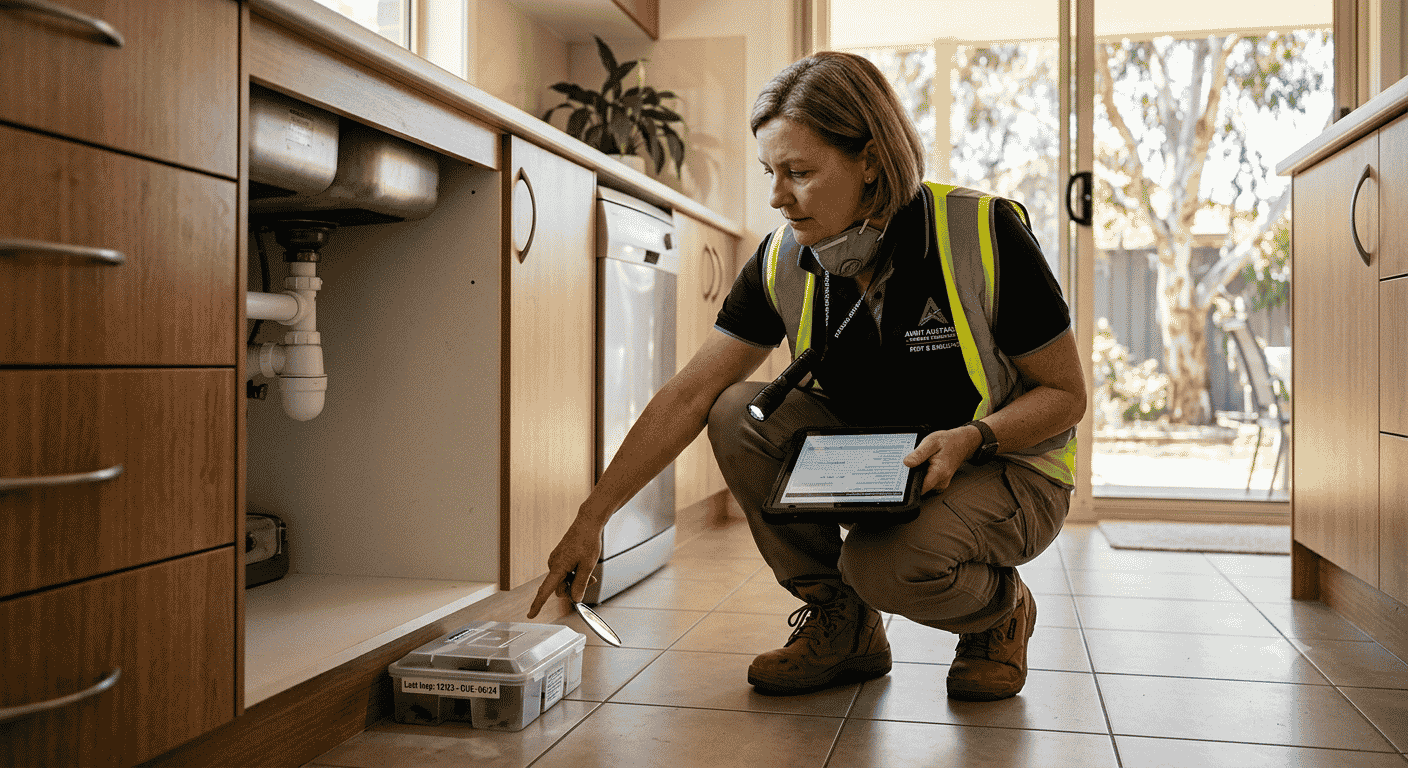
This is where many commercial operators fall short. Individual treatments may have been carried out competently and on schedule, but if the documentation does not exist — or cannot be produced — an auditor has no way to verify that.
What auditors look for:
- A dated service report for every inspection and treatment visit
- Reports that identify the areas inspected, the pest activity observed or confirmed absent, the treatment applied, and the products used
- For treatment reports: the specific pesticide product name, active constituent, application rate, and method of application
- Technician name and signature (or digital equivalent) on every report
- Any follow-up recommendations noted and actioned — auditors look for evidence that recommendations were not simply ignored
What to have ready:
A complete chronological file of all service reports, easily accessible and sorted by property or building. Gaps in the service report history — missing visits, undocumented treatments, or reports that do not include product details — are among the most common compliance findings in commercial pest management audits.
Safe Spray's Spectrum Portal stores all service reports digitally with full treatment details, technician records, and timestamps. Reports are downloadable individually or in bulk, making audit preparation straightforward regardless of how many sites are in your portfolio.
4. Chemical Use Records and Safety Data Sheets
The use of pesticides in commercial and strata environments is regulated under the Pesticides Act 1999 (NSW) and associated regulations. Auditors — particularly environmental health officers conducting council inspections — pay close attention to how pesticide use is documented and whether the products used are appropriate for the environment in which they were applied.
What auditors look for:
- Records of all pesticide products used on the premises, including product name, EPA approval number, active constituent, and application rate
- Confirmation that products were used strictly in accordance with their registered label — off-label use is a regulatory breach regardless of whether it caused harm
- Safety Data Sheets (SDS) for all products used, accessible on site or in the compliance file
- Evidence that pesticide use near food handling areas, water features, children's play areas, or ecologically sensitive zones complied with applicable label restrictions
- For strata buildings: confirmation that residents were notified of treatments in accordance with any applicable requirements, and that re-entry intervals were observed
What to have ready:
Current SDS documents for all products used in your building, cross-referenced against service reports. Your pest controller should be providing this information as a matter of course — if they are not, request it. Safe Spray includes product and SDS information in all commercial treatment documentation.
5. Termite Management System Documentation
For commercial buildings and strata schemes in Greater Sydney — particularly those with timber structural elements or landscaping against the building perimeter — termite management is a specific compliance area that auditors treat separately from general pest control.
What auditors look for:
- Evidence of a current termite management system installed and maintained in accordance with AS 3660.1 (Termite Management — New Building Work) or AS 3660.2 (Termite Management — Existing Buildings and Structures)
- For chemical soil barriers: installation certificates, product details, and evidence of the required re-inspection schedule (typically annual under AS 3660.2)
- For termite monitoring systems: inspection reports from every scheduled monitoring visit, with notes on bait consumption, termite activity detected, and any treatment responses initiated
- Warranty documentation from the installing company, including the scope of the warranty and any conditions (such as annual inspection requirements) that must be met to maintain it
- For buildings where no termite management system is installed: a documented risk assessment explaining why no system is required, and evidence of annual timber inspections
What to have ready:
Original installation certificates for any termite management system, all inspection reports since installation, and current warranty documentation. If your termite system was installed more than 12 months ago and no re-inspection report exists, this is a priority item to address before any audit.
6. Evidence of Pest Activity Monitoring Over Time
A single pest treatment, however thorough, tells an auditor very little about how a building's pest risk is being managed on an ongoing basis. What auditors want to see is evidence of continuous monitoring — a documented picture of pest activity trends across the property over time.
What auditors look for:
- Pest activity data from multiple inspection visits, showing whether activity levels are increasing, decreasing, or stable
- Evidence that monitoring results are informing treatment decisions — not just being recorded and filed
- Documentation of any significant pest events (a rodent infestation, a cockroach breakout in a food handling area, a termite find) and the response taken, including timeframes
- For buildings with ongoing pest issues: evidence of root cause investigation and corrective action, not just repeated treatments of the same problem
What to have ready:
A summary of pest activity findings across the last 12 months, ideally in a format that shows trends across multiple visit reports. This is one area where digital pest management platforms provide a clear advantage — aggregated trend data is far more compelling to an auditor than a stack of individual paper reports.
7. Notification and Communication Records
In commercial and strata environments, pest control treatments often require advance notification to occupants — whether for practical reasons (preparing food storage areas, vacating during fumigation) or regulatory ones. Auditors look for evidence that this communication was managed appropriately.
What auditors look for:
- Records of tenant or occupant notifications prior to treatments, including the date of notification, the method used, and the information provided
- For strata buildings: evidence that lot owners or the strata committee were informed of significant pest management activities, particularly treatments involving access to common property areas
- Where treatments were carried out in or near food preparation areas: evidence that appropriate food safety protocols were followed and communicated
- Any complaints or concerns raised by occupants in relation to pest control, and how they were responded to
What to have ready:
Copies of notification letters, emails, or text messages sent to occupants prior to treatments, retained in your compliance file alongside the corresponding service reports. For strata managers, relevant agenda items and minutes from strata committee or AGM meetings where pest management was discussed are also worth including.
8. Insurance and Public Liability Documentation
Commercial pest control work carried out on your premises creates a liability exposure — and auditors, insurers, and building owners are increasingly aware of it. If a pest treatment causes damage to property, illness to an occupant, or harm to a third party, the question of whether adequate insurance was in place will arise immediately.
What auditors look for:
- Evidence that your contracted pest controller holds current public liability insurance, typically a minimum of $20 million for commercial work in NSW
- For strata schemes: confirmation that pest control work carried out on common property is covered under the contractor's insurance, not assumed to fall under the owners corporation's building policy
- Certificates of currency for the pest controller's insurance, dated within the current policy year
What to have ready:
A current certificate of currency from your pest controller's insurer, renewed annually. Safe Spray carries full public liability insurance for all commercial pest management work and provides certificates of currency on request.
9. Environmental and Sustainability Compliance
For buildings with NABERS ratings, Green Star certification, or formal environmental management commitments, pest management practices are increasingly subject to sustainability-related scrutiny — particularly regarding chemical use and its environmental impact.
What auditors look for:
- Evidence that an Integrated Pest Management (IPM) approach is being followed — prioritising monitoring, prevention, and targeted low-impact treatments over broad-spectrum chemical application
- Documentation of the pest management approach in the building's environmental management plan or sustainability report
- Records demonstrating that pesticide use has been minimised and that non-chemical alternatives have been considered and applied where practicable
- For buildings near waterways, bushland, or ecologically sensitive areas: confirmation that all chemical applications complied with buffer zone requirements and label restrictions
What to have ready:
A statement from your pest controller confirming that their service program follows IPM principles, supported by service reports that demonstrate monitoring-led treatment decisions. Safe Spray's commercial programs are designed around IPM principles and can provide supporting documentation for environmental audits and sustainability reporting.
10. Complaints Register and Corrective Action Log
Finally, auditors look for evidence that your organisation has a functioning feedback loop around pest management — that complaints are recorded, investigated, and acted upon, and that recurring issues trigger systemic responses rather than repeated reactive treatments.
What auditors look for:
- A documented complaints register covering any pest-related complaints received from tenants, lot owners, or council officers
- Evidence that each complaint was investigated promptly and that a response was provided
- Where complaints identified a systemic issue (a recurring rodent problem linked to a structural gap, for example), evidence of corrective action — not just a repeat treatment
- Confirmation that the complaints register is reviewed periodically and that patterns of pest activity are escalated for investigation
What to have ready:
A simple complaints log — even a spreadsheet — recording the date, nature, and resolution of every pest-related complaint received. Cross-referenced against your service report file, this demonstrates a genuinely managed pest control program rather than a box-ticking exercise.
Preparing for Your Next Compliance Audit
The common thread across all ten areas above is documentation. Competent pest management that is not documented is, from a compliance perspective, indistinguishable from pest management that was never carried out. The standard of proof in any audit, dispute, or regulatory review is the paper trail — and building that trail consistently, from every service visit, is the most important thing a commercial property operator or strata manager can do.
Safe Spray works with commercial clients, strata managers, and facilities managers across Greater Sydney to deliver fully documented pest management programs through our Spectrum Portal — giving you real-time access to service reports, treatment records, technician credentials, and pest activity data across your entire portfolio.
If you are preparing for an upcoming audit, reviewing your compliance position, or simply want to ensure your pest management program meets the standards auditors actually apply, contact Safe Spray on 1300 562 053 or request a consultation online.